The Responsive City
Emir Saydam, Emine Simsek
SCI-ARC
Professor: Maxi Spina
In an era of increasing environmental uncertainty, how can architecture foster resilience that supports both immediate disaster response and long-term community adaptability? This question became the foundation of our thesis, The Responsive City. Set against the backdrop of global climate crises, our project investigates how architecture can go beyond static structures and evolve into systems that support dynamic, everyday use while being prepared for emergency conditions.
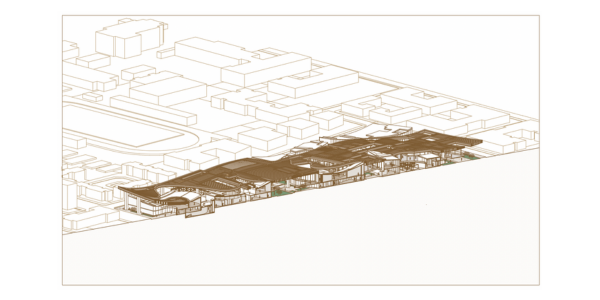
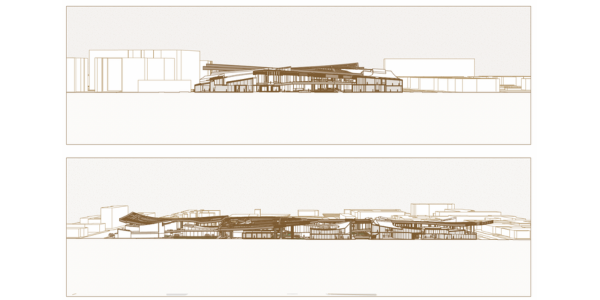
Our proposal envisions a multi-functional community center situated in Los Angeles, a city vulnerable to a wide range of disasters including wildfires, earthquakes, and extreme heat. Yet, instead of designing for the crisis as a separate state, we approached resilience as an everyday condition—one that must be embedded within the spatial, structural, and social fabric of the project. This community center is not simply a shelter in times of need, but a civic space for gathering, learning, and care—capable of transitioning fluidly between daily life and emergency response.
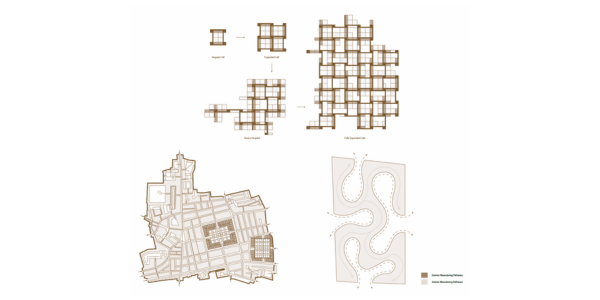
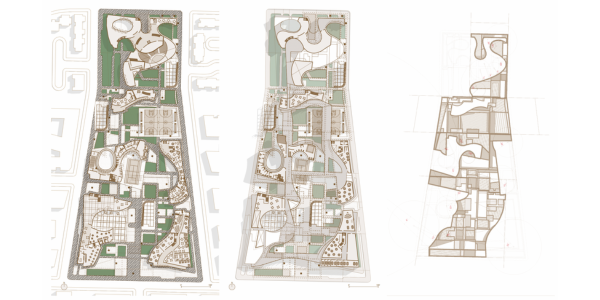
The design draws on mat-building typologies, known for their horizontal expansion, organizational flexibility, and ability to accommodate multiple programs within a continuous field. This approach allowed us to build a spatial logic that is both highly adaptable and contextually integrated. The plan’s porosity supports cross-ventilation, passive cooling, and fluid circulation between indoor and outdoor zones—important both for comfort in everyday use and survival in moments of crisis.
Our formal strategy is informed by a range of global precedents that have stood the test of time through adaptability: the Grand Bazaar in Istanbul, with its micro-city spatial organization; the Venice Hospital project by Le Corbusier, which envisioned modular healthcare infrastructure through mat-building logics; and the Okurayama Apartments in Japan, whose fragmented and meandering forms allow for human-scale interactions and community cohesion. These precedents, while different in scale and function, collectively offered us insight into how architecture can support both continuity and transformation.
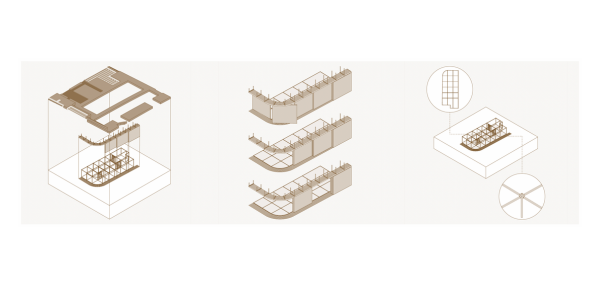
The architectural systems of our proposal include water collection and storage, shaded social courtyards, thermal mass strategies, backup energy infrastructure, and multi-use rooms that easily convert into dormitories, classrooms, or clinics. These elements are designed to work in both everyday and emergency scenarios—forming a toolkit of resilience embedded in the building itself.
We also considered the role of community agency and empowerment in the design. The project encourages co-ownership by inviting participation in its use and transformation. Spaces are open-ended, signage is legible and adaptable, and programmatic zoning remains intentionally flexible to accommodate shifting needs over time.
Ultimately, The Responsive City is a call for architecture that embraces change rather than resists it. It argues for design that is resilient not only through material robustness, but through adaptability, inclusivity, and contextual intelligence. As architects from Turkey—where disaster, adaptation, and collective resilience are part of the cultural DNA—we brought a personal urgency to this work. Combined with SCI-Arc’s experimental and critical environment, we were able to develop a project that is not only about buildings, but about systems.