Sea Ranch
Ena Yanchapaxi, Taeseung Seong, Imran Ahmed
University of California, Los Angeles | Architecture & Urban Design
Professor: Jeffrey Inaba and Tucker Van Leuwen-Hall
This project begins with a fundamental premise: sustainability is not a collection of technical solutions, but a way of life—one that reconnects human rhythms with the cycles of nature. The landscape is no longer a background for architecture but a living system we belong to. Within this understanding, our proposal for Sea Ranch addresses two interdependent cycles: the ecological and the demographic.
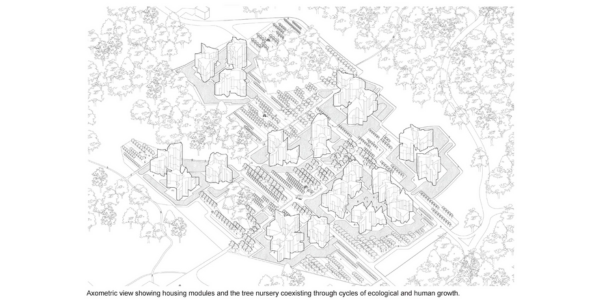
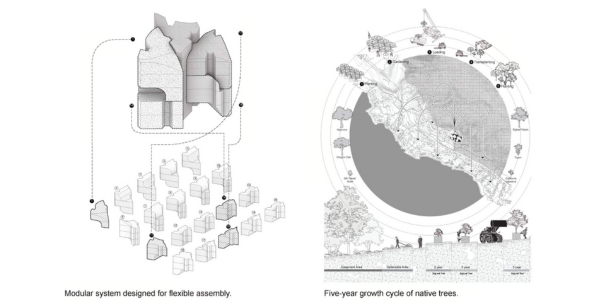
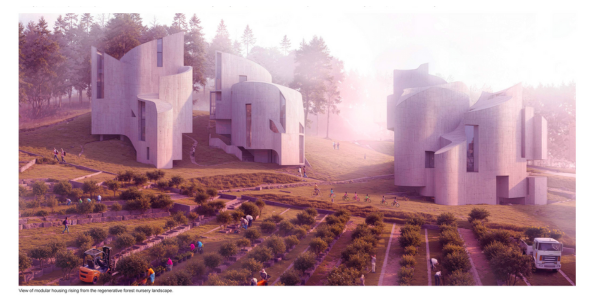
The ecological cycle focuses on the regeneration of native forests as a direct response to wildfire risk. Years of human intervention have disrupted natural renewal patterns, leaving vulnerable ecosystems and homogeneous vegetation. To restore balance, we introduce a native tree nursery organized in five-year cycles. This framework allows the landscape to grow through time, hosting trees in different stages of maturity that create a mosaic of color, texture, and age. The nursery cultivates species adapted to local soil and coastal climate, carefully selected for their resilience to wildfire and their ability to restore biodiversity. Once matured, these trees are replanted across Sea Ranch and northern California—transforming the site into a source of ecological renewal that extends beyond its boundaries.
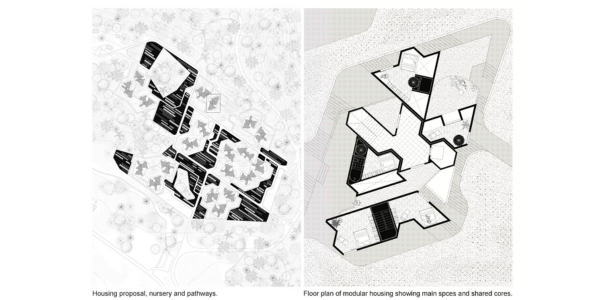
A network of pathways connects these growing zones with the housing clusters, allowing residents to walk through the evolving forest and witness its transformation. Former meadows, once passive, become active ecological fields that link human life to natural cycles. The landscape becomes a teacher—a space of awareness, coexistence, and care.
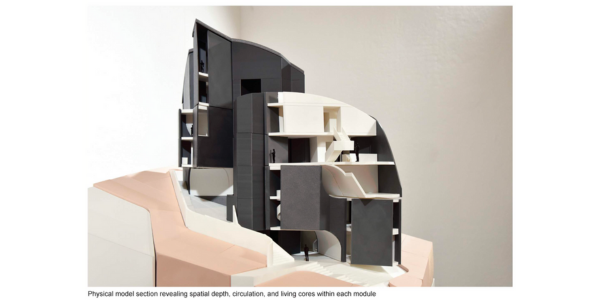
The demographic cycle addresses Sea Ranch’s changing social structure. Once imagined as an experimental community, it now faces the challenges of an aging population. Our project invites younger generations to settle here, bridging ecological and social regeneration. A modular and affordable housing system encourages diversity and participation. Each module adapts to the site’s topography, orientation, and resident preferences, allowing future occupants to configure their own living spaces. This flexibility fosters variety and a sense of authorship, transforming housing from a fixed object into a participatory process.
Each housing cluster forms terraces, patios, and shared courtyards that blur the boundaries between interior and exterior space. The architecture is porous, open to the climate and the forest. These spaces enable daily life to unfold within the rhythm of the landscape—where work, rest, and community interaction are shaped by light, vegetation, and terrain.
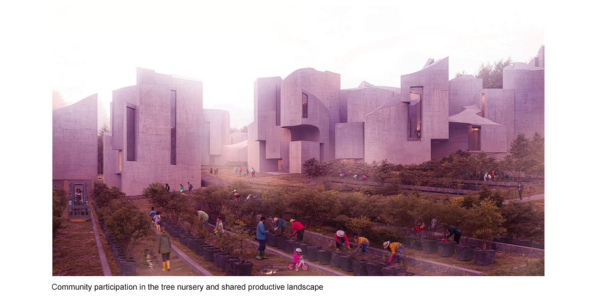
The nursery becomes the new civic space of Sea Ranch: a shared ground for care, learning, and collaboration. Here, residents are not passive observers of nature but active stewards who participate in cycles of planting, nurturing, and reforestation. The nursery grows more than trees—it grows relationships between people and the land, cultivating a sense of belonging rooted in time and responsibility.
Ultimately, this proposal redefines sustainability as a shared, embodied practice. It goes beyond minimizing impact to embrace the idea that we are nature—that the environment does not exist “out there,” but through us, around us, and within us. Architecture, forest, and community form one continuous living organism. What we propose is not only a plan for housing but a new way of inhabiting the world: one where people and the environment regenerate together.