Resilient Tides
Nayla Alejandre
University of Southern California, School of Architecture
Professor: Gillian Shaffer Lutsko
La Perla is a vibrant coastal neighborhood situated just outside the fort walls of Old San Juan. It has been developed over generations by workers and families who built homes using concrete, timber, and salvaged materials. This community has emerged organically, without formal plans, thriving on labor, necessity, and deep bonds among residents. The people of La Perla have long taken it upon themselves to maintain their own water lines, patch their walls, and rebuild after storms. This showcases a unique resilience grounded in collective resourcefulness and an unwavering spirit.
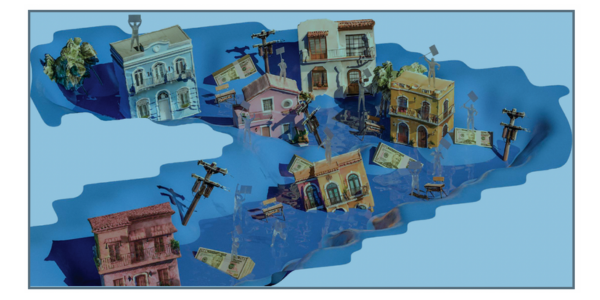
However, La Perla’s location along the shoreline presents significant challenges, exposing it to flooding, rising sea levels, and severe storms. When Hurricane Maria struck Puerto Rico, La Perla was among the hardest-hit areas, experiencing extensive destruction and delayed recovery. Despite the failures of traditional infrastructure, the community’s spirit endured, emphasizing that resilience is as much a product of human connection and solidarity as it is about physical structures. Building on this foundation of community strength, Resilient Tides proposes a self-built housing and infrastructural framework that leverages local knowledge and collective resilience. The project explores how architecture can effectively support the informal construction methods prevalent in Puerto Rican communities while simultaneously adapting to ongoing environmental changes. It introduces a modular kit designed for residents to construct their homes incrementally, which enables them to respond dynamically to shifting water levels and reclaim damaged land. This innovative approach frames architecture as a process marked by care, adaptability, and participation rather than one of permanence.
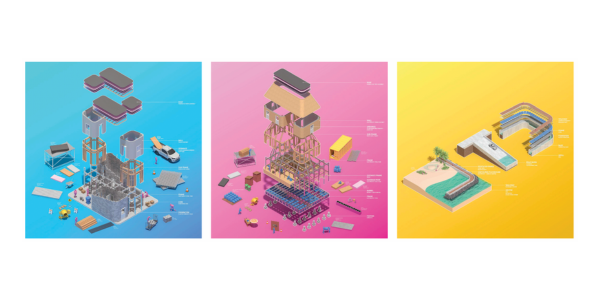
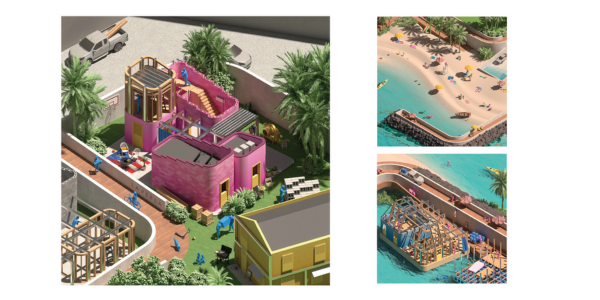
The design within Resilient Tides emphasizes two spatial archetypes: the porch and the courtyard. These forms draw inspiration from Puerto Rican vernacular traditions. The familiarity of these spaces enables the implementation of two adaptive strategies: terrestrial and amphibious. The terrestrial system consists of a concrete slab and a modular timber frame, fostering stability and growth on solid ground. Conversely, the amphibious system adapts this structure to be supported by a floating base, which allows homes to rise in tandem with fluctuating water levels. Both of these strategies highlight modularity, ensuring that homes remain repairable and accessible to the local community. Each home within this framework develops through three key actions: Protect (anchoring daily activities within a resilient core), Grow (facilitating space for flexible expansion), and Connect (promoting social interaction through shared porches).
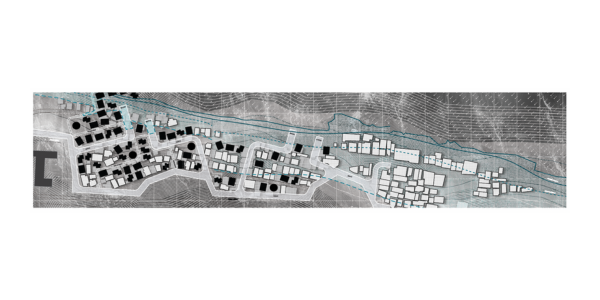
At the neighborhood scale, this design initiative integrates coordinated infrastructures aimed at managing water and stabilizing land. Elements such as amphibious walkways and vegetated dunes work synergistically to capture stormwater and protect against erosion. Together, these systems create a layered network of protection and renewal, transforming La Perla’s coastline and converting past damage into opportunities for collective rebuilding and revitalization. In essence, Resilient Tides envisions architecture as an evolving process shaped by community dynamics. It offers a model for empowering communities like La Perla, allowing them to actively craft their futures through participation and adaptability. The project reflects a deep understanding of local needs and contextual challenges, fostering resilience not just in structures but in the very fabric of community life. By reimagining the possibilities of home and infrastructure, Resilient Tides paves the way for a sustainable and hopeful future rooted in the strengths of its people.