Emberbreak City
Woodbury University - School of Architecture
Professor: Carlo Sturken
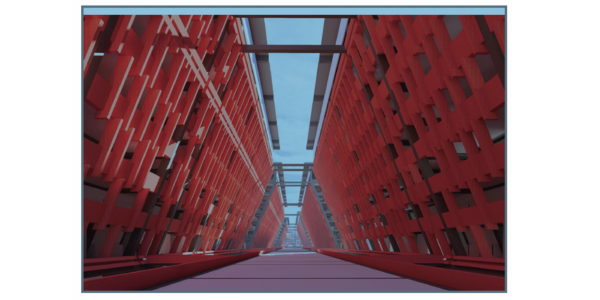
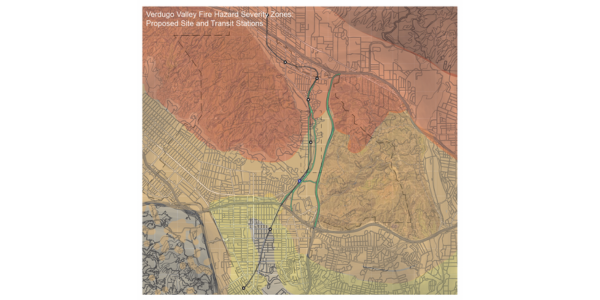
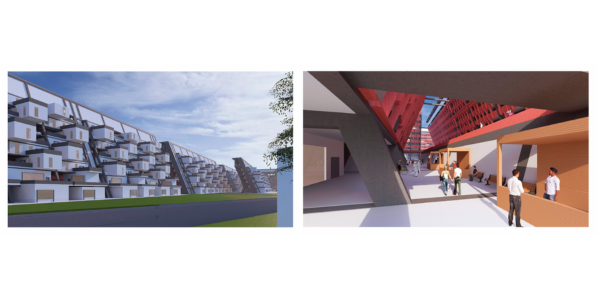
Wildfires driven by seasonal winds increasingly threaten the urban fringe of the Verdugo Woodlands. Emberbreak City aims to mitigate airborne embers with a line of concrete superstructures along the Verdugo Wash. This approach reimagines urban co-existence at the wildland-urban interface, by disrupting embers movement, reducing the risk of wildfire spread, and maintaining porous connections between the modules and the surrounding environment. The system integrates multi-level, modular units into a regional superstructure that doubles as wildfire defense and urban expansion. With replaceable modules, vertical layering, open terraces, and public transit, it forms a resilient, adaptive framework for living with fire.
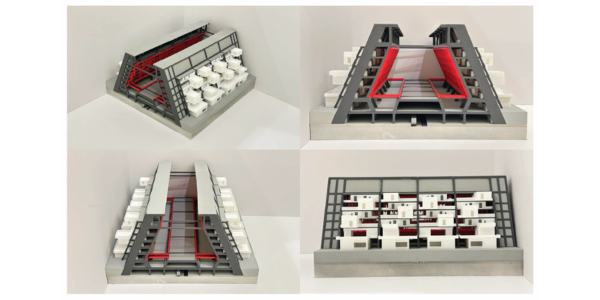
The Verdugo Woodlands has long been prone to wildfires—an issue intensified by modern fire suppression methods that prevent smaller, naturally occurring burns. This has left the area especially vulnerable to large-scale fires, whether through wind-carried embers or the ignition of tightly packed vegetation and singlefamily homes. Emberbreak City proposes a new urban edge: a fire-resistant urban structure that mitigates wildfire risk while remaining permeable to people, public spaces, and transit. Drawing from Brutalist and Metabolist principles, the design features robust concrete foundations for fire resistance and modular units that can be added, removed, or reprogrammed as community needs evolve. Each module supports diverse functions—ranging from housing and offices to retail and cafes—encouraging flexible, adaptive use. Situated along the Verdugo Wash and major streets, each module integrates with new and existing park spaces and pathways, aiming to revitalize the river corridor while forming a resilient buffer between nature and the built environment.
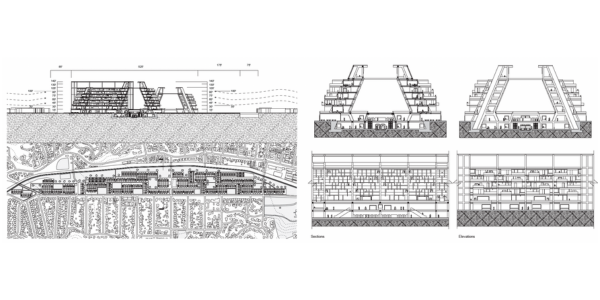
At the heart of this strategy is Emberbreak City’s modular superstructure, where transit, commerce, and community services are woven into a flexible, multi-level framework. Departing from conventional suburban zoning that separates residential from commercial areas, the system fosters mixed-use development within a resilient, adaptable form. Replaceable modules allow the urban edge to evolve alongside community needs, ensuring long-term relevance and adaptability. Emberbreak City is anchored by an underground rail system threaded through robust concrete corridors designed to withstand fire and heat. Each hub is vertically layered, with main nodes having train lines underground, with every node having commercial and office spaces on the first and second floors, and with housing units above. Open terraces and porous connections between modules create breathable, adaptable spaces that link residents to both the city and its surrounding environment, strengthening resilience at the wildfire-exposed edge.