The East West Players
Chelsea Mae Santos
California State Polytechnic University, Pomona
Professor: Robert Alexander
The East West Players has long been a cornerstone of Asian American theater, elevating underrepresented voices and reshaping the cultural landscape of Los Angeles. Yet, as the organization continues to grow, experiment, and expand its programming, its current home—a repurposed church—can no longer accommodate its ambitions. This project envisions a new, purpose-built theater complex in Little Tokyo, providing a contemporary platform for creative exploration while honoring the history and legacy of the original East West Players venue.
At the heart of the design are two interdependent volumes that embody the duality of theater: performance and production, spectacle and support, visibility and labor.
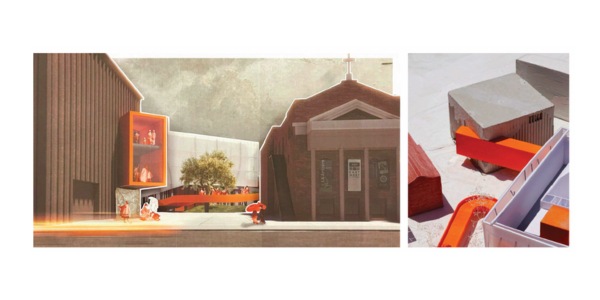
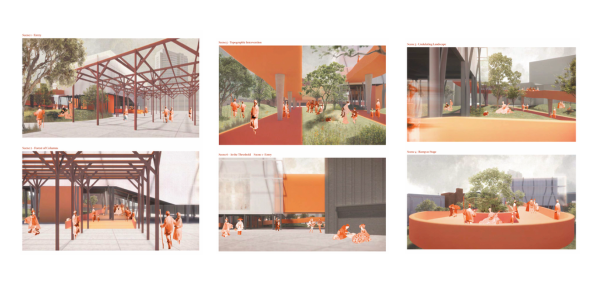
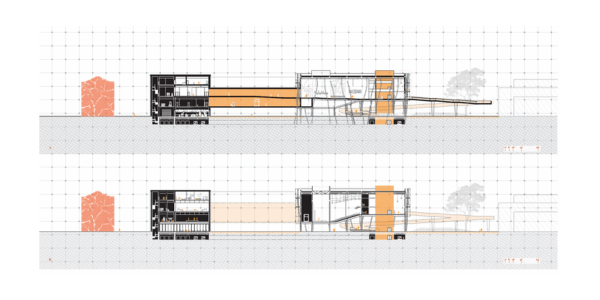
The Floating Playhouse is the architectural centerpiece, the heart of artistic expression. This elevated, translucent volume houses the main theaters and their supporting spaces. At night, it glows like a lantern, radiating energy and drawing the public into the world of performance. Supported by sculptural “silly columns,” the Playhouse introduces theatricality and playfulness while engaging the civic realm beneath. The main proscenium theater, the David Henry Hwang Theater, honors the legacy of the original venue, while the Andy Lowe Black Box Theatercelebrates the contributions of the recently retired artistic director. Beneath this luminous structure, the open ground plane becomes an urban stage, an intentional public space for rehearsals, workshops, and spontaneous performances that blur the boundary between theater and city.
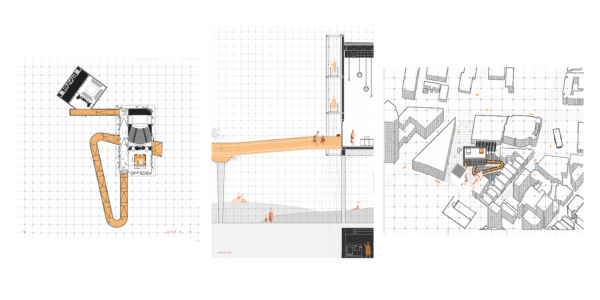
In contrast, the Support Tower is a grounded, opaque monolith that anchors the complex both physically and symbolically. It houses the essential yet unseen operations of theater: rehearsal studios, dressing rooms, costume and set storage, technical workshops, and administrative offices. Acting as a hinge between the new facility and the historical church, the tower embodies the enduring infrastructure of creativity—the quiet labor that sustains artistic performance. Strategic windows punctuate both volumes, offering curated glimpses into back-of-house activity and revealing that performance extends beyond the stage into the work that makes it possible. A bridge physically and conceptually connects the Playhouse and the Support Tower, reinforcing the inseparable relationship between spectacle and support.
The architectural narrative extends into the visual composition of the project. In renderings, the foreground frames the existing church alongside the Support Tower, forming an architectural proscenium that grounds the composition in history. The midground introduces the Floating Playhouse and winding ramp, representing the active stage of public engagement and performance. In the background, the Geffen Contemporary and the sky act as a sky drop, situating the theater within the broader cultural landscape of Los Angeles. This layered approach frames the building as both performer and platform, simultaneously rooted in legacy and projecting toward the future.
The structure itself embodies this duality through a hybrid system. A concrete podium and Support Tower provide mass, durability, and acoustic stability, grounding the building physically and symbolically in Little Tokyo. Above, a lightweight steel framework allows the Playhouse to float expressively, creating a luminous, ethereal volume. The contrast between concrete and steel mirrors the theater’s dual nature: anchored in tradition yet open to innovation, permanence paired with adaptability.
Circulation is choreographed as an experiential journey. A grand ramp weaves between the silly columns, guiding visitors through sightlines into rehearsal rooms and stages, transforming movement into an act of discovery and participation. The ramp itself becomes a stage, inviting impromptu interactions that merge the audience with the performance. The lifted Playhouse creates an activated public realm beneath—a civic stage that extends theater into the city, fostering connection and spontaneity.
Aligned axially with the Geffen Contemporary at MOCA, the new East West Players Theater engages in dialogue with its cultural surroundings, contributing to the urban fabric while reinforcing Little Tokyo as a hub for Asian American arts.
Ultimately, this project redefines the identity of East West Players. By balancing performance with production, lightness with solidity, and visibility with labor, it creates a theater that is not only experienced but lived—a luminous architecture that celebrates creativity, community, and cultural continuity.